











Which custom label suppliers should distributors consider for wholesale orders?
Oct 21, 2026
Digital-first label printers, online or web-to-print platforms, and full-service converters with digital press capabilities answer the question of what are the best label suppliers for brands that need frequent SKU changes. Frequent changes need short runs, fast reorders, variable data, and clean versioning across many SKUs. A supplement brand with several flavors shows the strain: every new SKU needs fresh artwork, and every label must stay accurate. These suppliers handle that load in different ways. This comparison uses practical criteria, so you can match a supplier to your brand. Digital label printing shortens runs; the right partner keeps each SKU compliant.

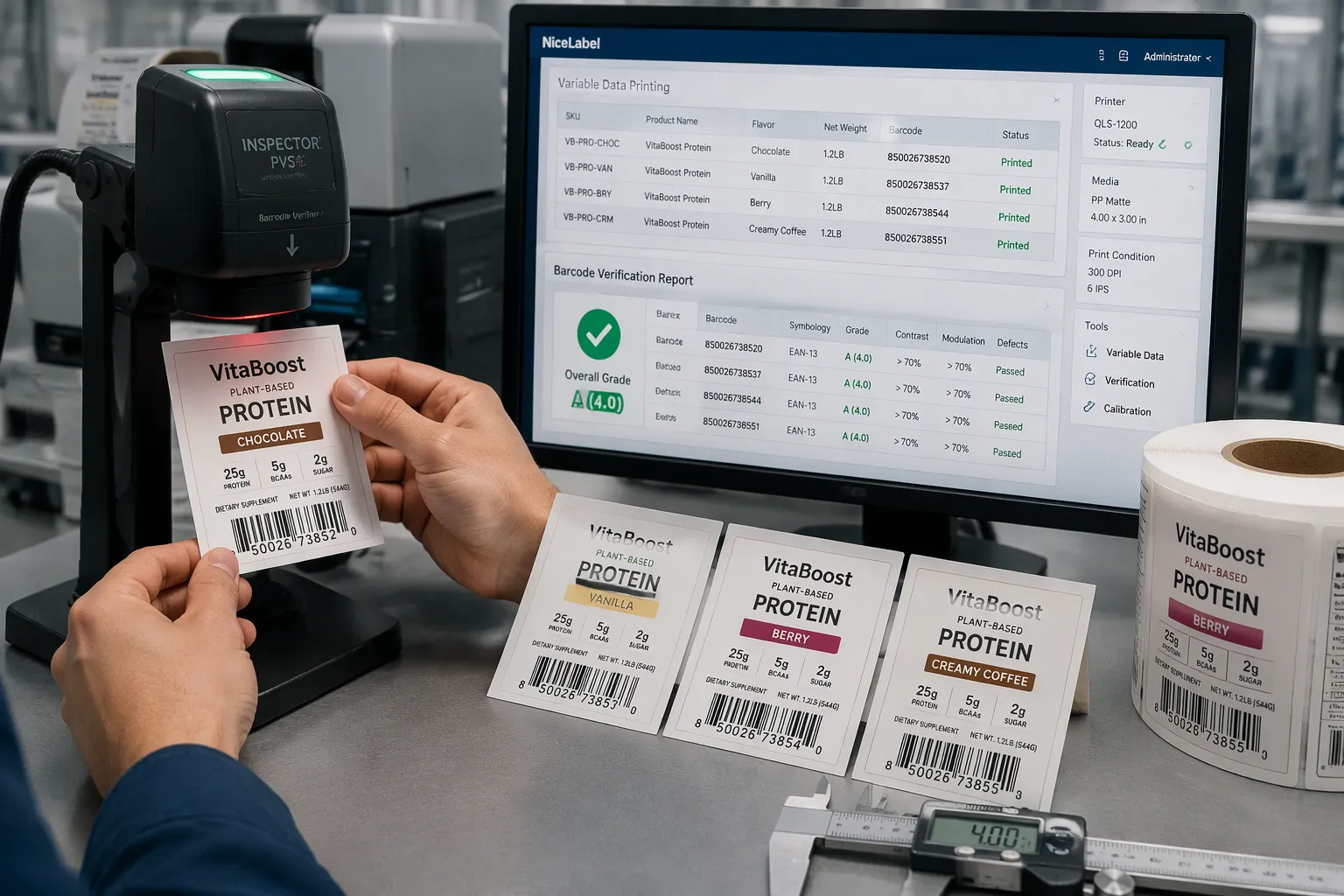
Four criteria decide if a supplier fits a fast-changing product line: technical performance, application fit, regulatory compliance, and cost. Technical performance covers print quality, variable data handling, and barcode accuracy. Application fit covers material, adhesive, and the environment the label faces. Compliance covers rules such as FDA labeling and GS1 barcodes. Cost covers the per-unit figure and the total cost of short runs, including setup and waste.
Barcode accuracy deserves its own check. Verification grades each symbol on decode, symbol contrast, modulation, defects, decodability, minimum reflectance, edge contrast, and quiet zone, per Midcom Data. A failed decode makes the whole symbol an F, and a cut quiet zone is one of the most common causes of an otherwise good barcode grading F. Standard UPC and EAN symbols need a quiet zone of 10X, ten times the narrow bar width, according to Certified Labeling Solutions.
Variable data printing pulls each record from a verified database, so manual entry errors drop sharply, per STTARK. It also lets you print different SKUs or variants within a single run, which cuts changeover downtime and the risk of applying the wrong label to the wrong product, per Systems Graphics. A supplement brand with several flavors can print small orders for each variation instead of one large batch, per Blue Label Packaging.
Match the material and adhesive to the surface and the storage conditions. A chilled product, an oily cosmetic bottle, and an outdoor device each demand a different face stock and adhesive. Compliance then sets the content rules. FDA rules for dietary supplements require a Statement of Identity, net quantity, a Supplement Facts panel, an ingredient list, and responsible firm information, per BSCG. Structure and function claims need the FDA disclaimer in bold type, and firms must notify FDA within 30 days of first marketing.
Cost behaves differently at short volumes. Plate-free digital printing offers the best per-label value at low volumes because it removes upfront tooling costs, per Resource Label. At higher volumes, flexo throughput offsets the plate cost. Combining multiple SKUs into one order lowers the per-label cost, but only labels of the same size and material can share a run. Keep your SKU naming and printing rules consistent, and treat SKU, UPC, and barcode as separate systems: the SKU is your internal identifier, the UPC is the retail code, and the barcode is the scannable symbol. Smart SKU optimization and inventory management then ripple into more cost-efficient label spend.
Digital label printing skips the plate and film costs that flexographic presses have, per Labels Unlimited. That changes the cost picture for a sku label order. You can print 5 or 20,000 labels, and the setup time and cost stay the same, per Labels Unlimited. Short-run labels are usually any amount under 10,000 labels in a run, and you no longer need minimum order quantities.
Digital inkjet label presses print several colors at once, which shortens lead times and lowers costs, per Tailored Label. Digital inkjet printing also works well for prototypes and small runs without big upfront costs. A 500-label roll order becomes easy, per LabelValue. So digital label printing fits short-to-medium run production for brands that manage many skus with frequent updates.
Digital label printing fits best when your skus change often and your volumes stay modest. Frequent artwork changes cost nothing extra in plates, so you can send revised label artwork and reprint without new tooling charges, per Labels-SP. Versioned artwork for seasonal campaigns or regional variants also runs cleanly on digital inkjet label presses. Short-to-medium runs of several skus can share one production window, which supports short-to-medium run production across a supplement line with many flavors.
Watch how you structure your orders. Each sku still needs its own order, and outsourced suppliers often set minimums of 1,000 to 10,000 units depending on substrate, size, and complexity, per Arrsys. Standard lead times of 8 to 10 business days leave room for demand shifts, per Arrsys. Pre-printed inventory goes to waste after a design change, per Arrsys. Proofing errors in bulk orders may show up only at delivery, per Arrsys. Plan reorder points for each sku and confirm proof approval early.
Web-to-print platforms put a storefront online. You upload artwork once, then order any SKU in the catalog whenever you need it. The platform stores approved files, so each reorder pulls the correct version. This model suits brands that manage many skus with steady, repeating demand.
Order flexibility is the main strength. You log in, pick a SKU, set a quantity, and check out. No email threads, no re-quotes. Approved files stay on file, so a new SKU variant goes live as soon as you upload it. Platforms often accept small quantities, which removes the minimum order quantity barrier that blocks frequent changes. A supplement line with ten flavors can order each SKU separately and keep stock balanced.
Digital storefronts also keep version control in one place. Every SKU label traces back to one approved file. That discipline cuts the risk of printing an outdated design. For on-demand label requirements, the platform model keeps reorders fast and predictable.
These platforms fit brands with a stable catalog and repeat orders. They suit teams without a print buyer, where a marketing manager places orders directly. They also fit on-demand production needs, where you order small batches as stock runs low.
Watch the limits. Platform templates may restrict size, material, and finish options. Complex constructions or specialty adhesives often fall outside the catalog. Confirm that each SKU meets your compliance rules before you approve the file. Check the platform's proofing step, too. A stored file reprints exactly as saved, errors included. Review every SKU before the first order, and audit the catalog when regulations change.
Digital platforms shine when your SKU count grows faster than your print budget. Keep a master list of sku labels and their approved versions. Assign one owner per SKU, and set a reorder trigger for each SKU. Small batches keep waste low when a design changes. Set the trigger before stock hits zero. A full-service converter such as Wenzhou Baihengyu Printing can bridge the gap when a platform catalog falls short.
A full-service converter takes care of design, printing, finishing, and delivery all in one place. That range helps when a sku label has to hold up in a tough environment. The same team that prints the job also gives you advice on materials and adhesives. Specialty stocks, custom adhesives, and multi-layer constructions are still within reach. Digital inkjet label presses in the plant speed up proofing for short-to-medium runs, so a new sku does not wait on a long tooling cycle.
Compliance support is the bigger strength. A converter can check label requirements against FDA rules and GS1 barcode standards before production begins. Variable data printing then puts lot codes and expiration dates on each label without manual entry. Versioned artwork for regional or seasonal variants stays organized in one workflow. Your label artwork moves through proofing, approval, and print with fewer handoffs. Fewer handoffs mean fewer version errors across your skus.
These suppliers fit regulated categories and complex applications. A supplement brand with many flavors and strict panel rules gains from one partner who knows every sku. Brands that need short-to-medium run production across mixed materials also benefit. Digital capability keeps short-to-medium runs affordable, and the converter's pressroom covers the larger volumes later.
Watch the setup. Confirm which services are done in-house and which get outsourced. Ask how the converter tracks artwork versions across a growing sku list. Set a clear approval step for each label before reorders. Using one supplier can reduce delays and improve consistency, yet multiple suppliers still make sense when one catalog cannot cover every construction. Match the model to your label needs, not to a ranking.
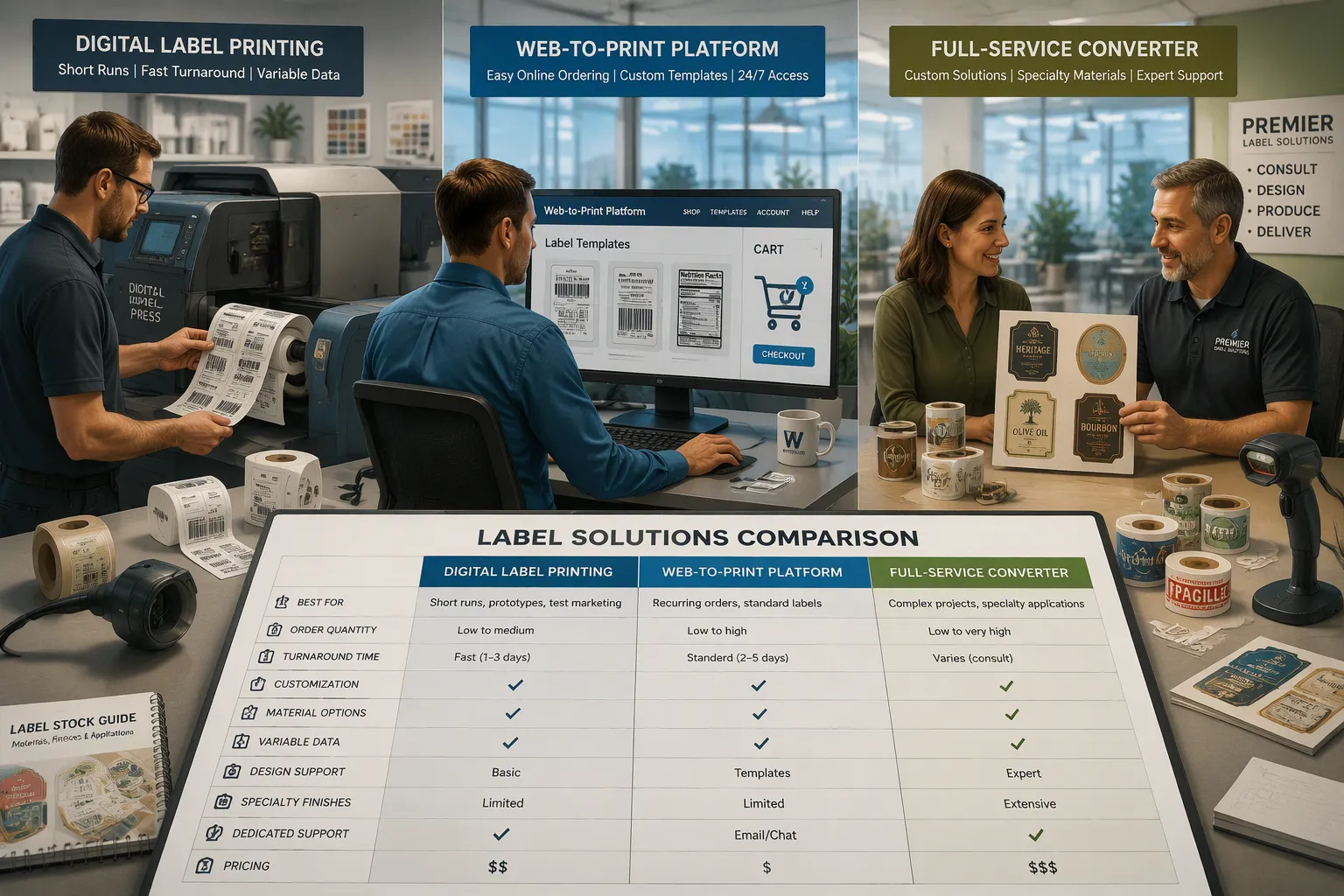
The table below compares the three supplier types using the criteria from the first section. Use it to make a short list of candidates, then check each detail with the supplier before you commit.
| Criterion | Digital label printing suppliers | Online and web-to-print platforms | Full-service converters |
|---|---|---|---|
| Technical performance | Variable data is easy; barcodes are tested before the run, per Labels Unlimited | Template fields only; limited variable data | Variable data plus in-house barcode checks |
| Application fit | Paper, vinyl, polyester, and polypropylene stocks, per Labels Unlimited | Catalog materials and finishes | Specialty stocks and custom adhesives |
| Compliance | Barcode checks before print | You confirm each file | Checks FDA rules and GS1 formats, including GS1-128 with the (01) identifier first, per KeHE |
| Cost | No plates or setup fees at low volume | Fixed catalog pricing | Quoted per job; digital presses keep short runs affordable |
| Turnaround time | 5 to 10 business days, per Labels Unlimited | Checkout is instant; production follows | Quoted per job with rush options |
| Order flexibility | Minimums from 100 units, per Labels Unlimited | Small quantities, no re-quote | Short and long runs from one roof |
Match the supplier to your run pattern and your risk. A brand with many skus and modest volumes fits digital label printing. A stable catalog with repeat orders fits a web-to-print platform. A regulated line with complex applications fits a full-service converter. Ask each candidate whether they run their own presses, check barcodes to ANSI/ISO standards before shipping, and keep your dies and plates on file, per Certified Labeling Solutions. Confirm the minimum order, the price curve as volume climbs, and the color capability, per Labels Unlimited. Get the standard lead time in writing. A brand that ships to retailers also needs case-level barcodes, such as ITF-14 or GS1-128, placed on two sides of the case, per KeHE. Avoid red, blue, brown, and purple in barcodes, per KeHE.
Consolidation changes the math. One supplier reduces complexity, speeds approvals, and improves consistency across batches, per Labeling Ad. Fewer suppliers also cut specification errors and version mismatches. Consolidation pays off when your list grows and your reorder volume climbs. One partner centralizes purchasing, optimizes inventory levels, and reduces administrative burden, per Labeling Ad. A strategic labeling partner helps you move faster and reduce risk, per Labeling Ad. Keep multiple suppliers when one catalog cannot cover every construction, or when a second source protects peak demand.
The goal is fit, not a ranking. Each model serves a different brand. The right mix depends on your sku count, your artwork change rate, and your compliance load. Keep one approved file per sku. Assign one owner per sku. Set a reorder trigger for each sku. When a sku changes, update the file before you reorder. A sku label should trace to a single master record, and sku labels across the line should share one naming rule. Review every sku before the first order. Small batches keep waste low when a design changes. This is how you answer the core question: what are the best label suppliers for brands that need frequent sku changes? Match the model to your own pattern.
Match the supplier to your pattern. Brands with many changes and low volume tend to choose digital label printing or online platforms. Brands with rules to follow or hard-to-label products tend to choose full-service converters that also print digitally. Custom label solution providers can work with you to find each label's needs and confirm the best fit.
Run this checklist before you commit:
Update your artwork file before each reorder. That habit answers what are the best label suppliers for brands that need frequent sku changes.
Begin by looking at how often your labels change and how many you order. Lines with many changes and low volume work well with digital label printing or online platforms. Products with rules to follow and complex materials fit full-service converters. Ask each supplier how they keep track of approved files for each SKU. Their answer shows whether they can keep up as your list grows.
Yes, if the supplier uses digital presses along with regular equipment. Digital takes care of the short, frequent runs. The same plant can handle bigger batches later. Make sure you know which services are done in-house. Ask how they move a SKU from proof to production without losing the approved artwork version.
Check the barcode grade, whether the material fits, and the compliance content. Make sure the quiet zone meets the 10X standard for UPC and EAN symbols. Confirm the file matches your master record. Give one person ownership of each SKU. Look over the proof before the first order, not after it arrives.
Consolidation helps when your SKU count grows and your reorder volume goes up. One partner speeds up approvals and keeps batches more consistent. Keep a second source when one catalog cannot cover every construction. A custom label solution provider such as Wenzhou Baihengyu Printing can review each label's needs and confirm the best fit.
Look at the choice again when your run pattern shifts, your compliance load changes, or a new SKU family joins the line. The answer to what are the best label suppliers for brands that need frequent sku changes? depends on your current pattern, not a fixed ranking. Review the fit each year.