












What are the best label suppliers for brands that need frequent SKU changes?
Nov 3, 2026
Three kinds of suppliers can provide labels as part of a coordinated packaging set: full-service packaging converters, integrated packaging distributors, and online packaging platforms. Each one runs labels, boxes, inserts, and marketing print through a single production plan. You will see how each type does on technical quality, application fit, regulatory compliance, and cost. A comparison framework comes next, along with a step-by-step guide for choosing suppliers that can provide labels and printed parts that match your branding. Use it to shortlist a supplier with confidence.
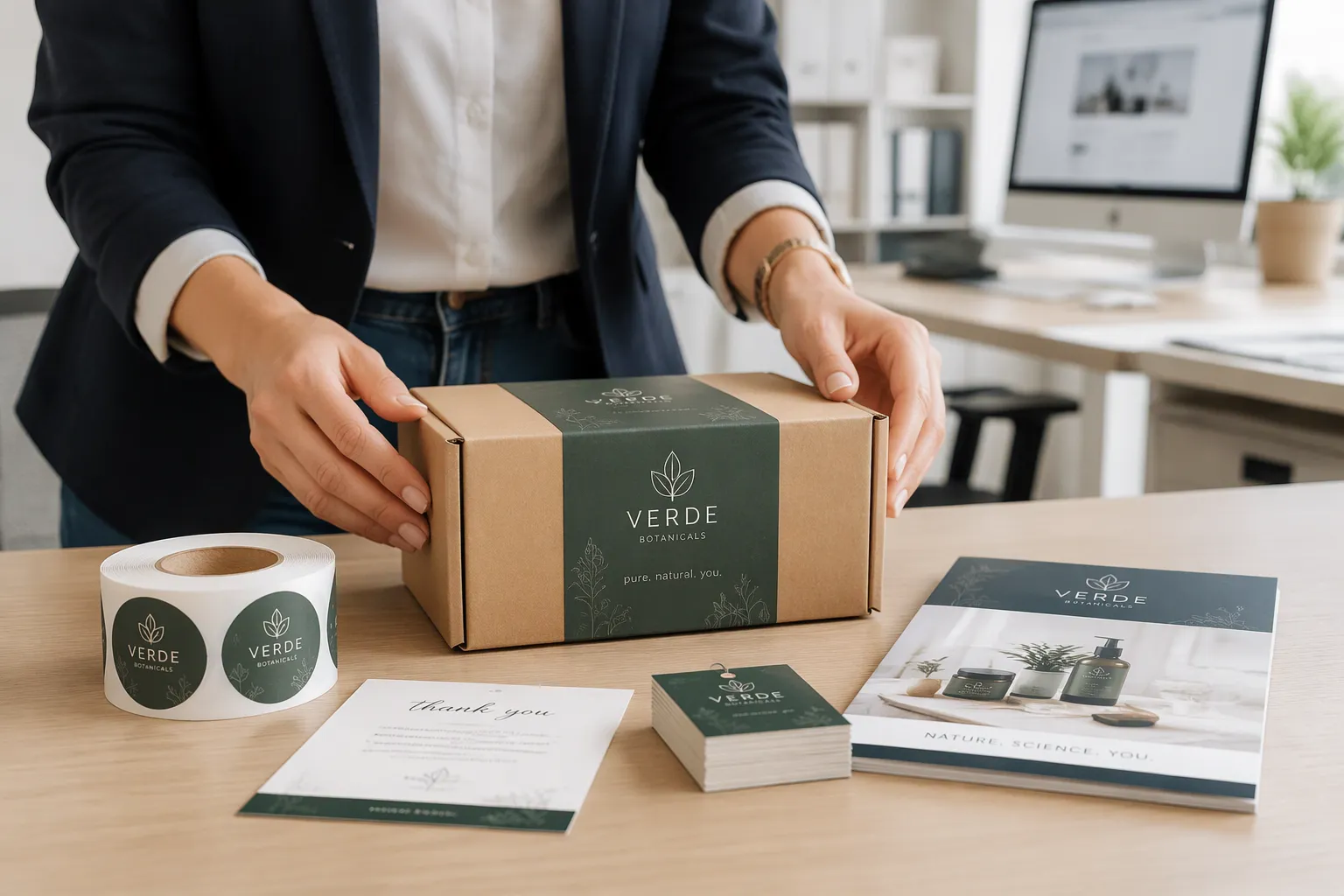
A coordinated packaging set means labels, boxes, inserts, and marketing print are made to work together as one system. Each piece shares the same color, logo, and voice. The 4over4 package marketing guide calls this a handful of coordinated surfaces. The box delivers shelf presence, the label carries the name and promise, and the insert turns the package into a direct channel for the next purchase. Consistency across every surface is what makes the package feel intentional.
When you source custom boxes, labels, tissue paper, printed inserts, and promotional materials from one plan, you get a complete pack-out that matches from the first touch to the final insert card. That is the core of a customized packaging set.
Single-source coordination matters for three reasons. First, you get a consistent brand presentation across every component. Second, materials and finishes stay compatible, so a matte label sits correctly on a matte box. Third, you cut the number of vendor handoffs and the errors that come with them.
Professional suppliers guide brands on compatible materials and finishes when combining stickers, labels, and boxes. This support protects your branding when you build coordinated presentation packaging across multiple product types. A supplier who understands the full set can flag a finish mismatch before production starts. That is why the question of which suppliers can provide labels as part of a full set matters so much. The profiles that follow show where each supplier type fits best.
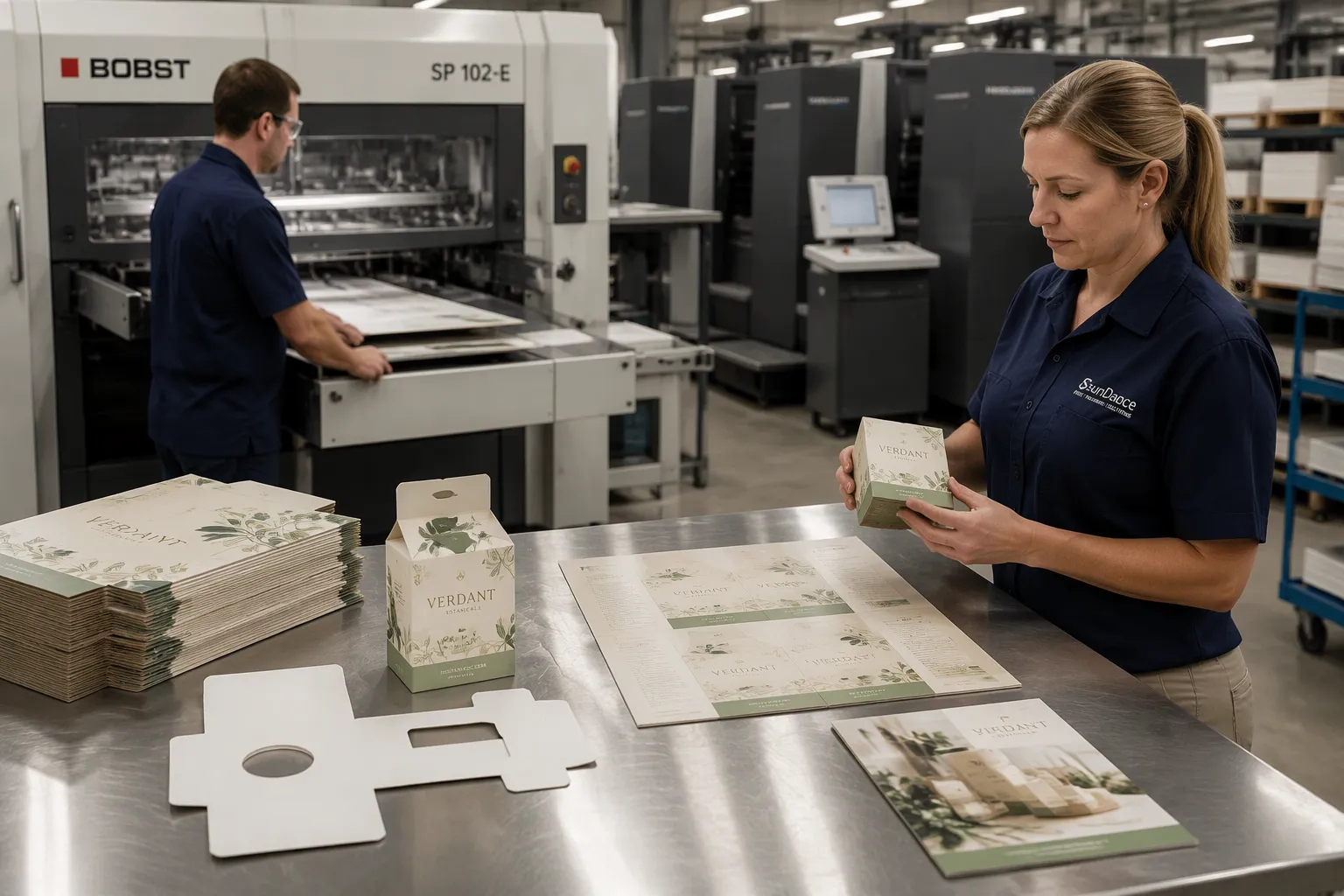
Three supplier models can deliver a coordinated set, and each fits a different buying situation. The question of which suppliers can provide labels alongside boxes and inserts comes down to model fit: run complexity, volume, and timeline.
A full-service converter handles design, printing, die-cutting, and finishing under one roof. PM Packaging, for example, runs in-house structural design, high-precision lithographic printing, die-cutting, folding, and gluing for custom printed paperboard cartons. This source manufacturer model keeps design, print, deep processing, and logistics in one facility. That structure fits complex, tightly specified sets where every component must match. A one-stop shop for printing and packaging needs removes the handoff risk that splits color and finish across vendors.
Converters typically cover the full production chain. A survey of carton manufacturers by Jewelry Pack Box lists these in-house capabilities:
For a coordinated set of labels, custom boxes, printed inserts, and marketing print, a single supplier owns the color match and finish across every piece.
Integrated distributors offer multi-SKU breadth and consolidated ordering. RRD, for instance, provides a packaging solution that helps brands customize labels and packaging, speed time to market, reduce inventory, and lower total costs. Distributors also bundle packaging products and branding services across many SKUs. A partner that covers printing, packaging, and distribution can absorb your printing, packaging, and distribution needs under one contract. RRD's analysis of consolidating packaging and label providers shows the operational payoff:
| Benefit | What consolidation delivers |
|---|---|
| Consolidated ordering | Fewer vendors, fewer purchase orders, lower administrative overhead |
| Reduced time to market | Faster artwork proofing and label encoding under one process |
| Tighter alignment | Fewer handoffs and greater control across the lifecycle |
| Consistent branding | One partner for cartons, labels, and tags keeps color and layout aligned |
Multi-version labeling adds efficiency. United Ad Label notes four gains:
Online platforms win on speed and low-volume simplicity. Printplace lets you order a full set or separate parts, choose size, shape, and material, and design online. Its range includes:
NextDayFlyers prints packaging in a variety of sizes and shapes, with custom product boxes, mailer boxes, pouches, and labels. Packlane serves over 25,000 brands with instant quotes and tiny minimums. The Custom Boxes brings 15+ years in the custom packaging industry with a 150+ member team. Shortlist established US custom box companies such as Packlane and The Custom Boxes.
Each model earns its place. Converters suit complex sets, distributors suit breadth, and platforms suit speed. The right suppliers protect your branding across all four components.
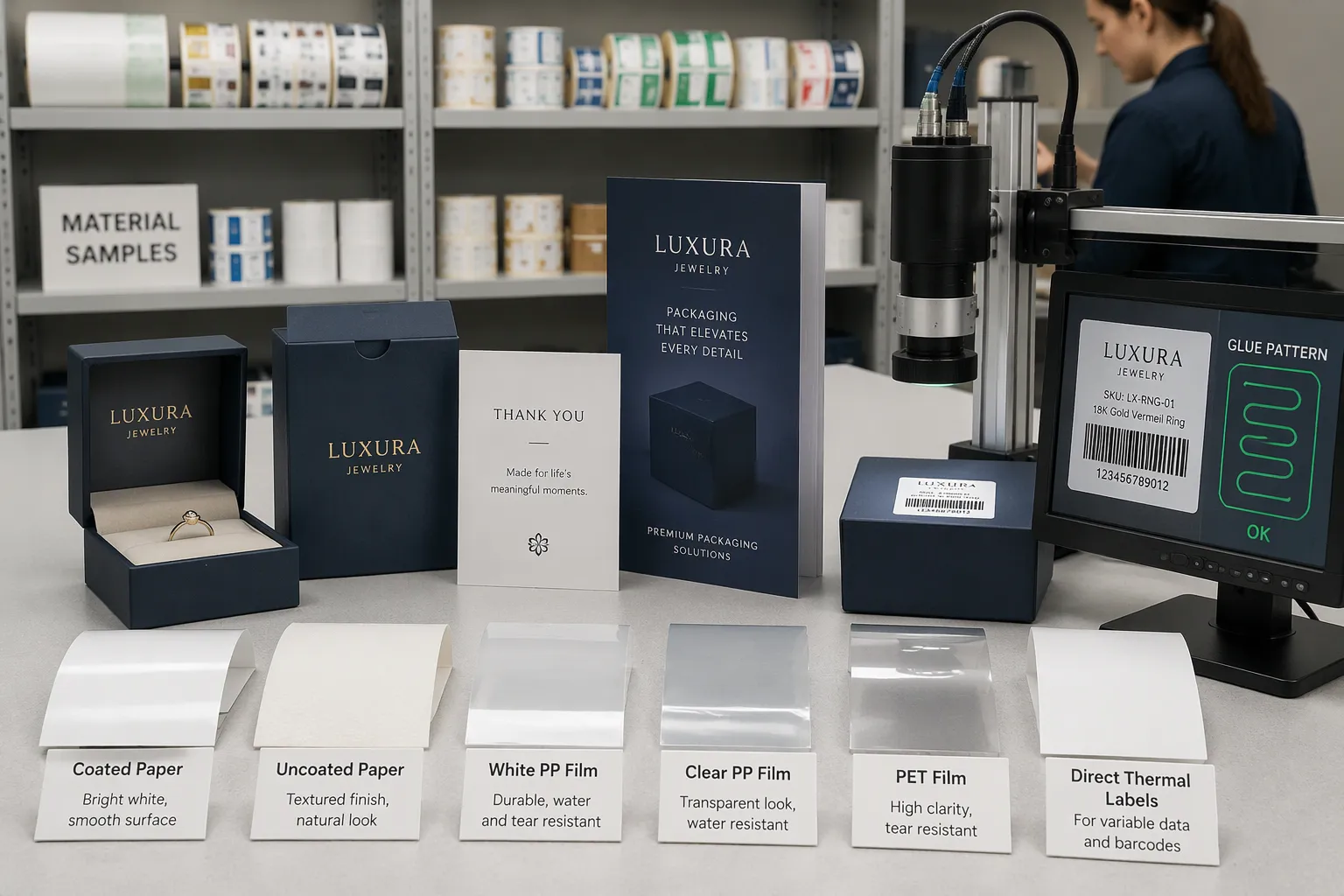
Begin with the range of materials and adhesives. A good supplier matches the label material to your container's surface, temperature, and moisture. The Zonbon Machinery label production guide sorts labelstock into coated paper, uncoated or specialty paper, white PP film, clear PP or BOPP film, PET film, and direct thermal stock. Each type has its own way of printing and die-cutting.
| Label Material | Typical Consideration |
|---|---|
| Coated paper | Everyday product labels for normal indoor use |
| Uncoated or specialty paper | Textured or touchable material for visual appeal |
| White PP film | Resists moisture for food, beverage, and personal care |
| Clear PP or BOPP film | See-through labels with a no-label look |
| PET film | Strong labels for industrial and electronic use |
| Direct thermal | Labels for shipping, retail, and barcodes |
Finishing skills decide whether your set looks unified. Packsmart Inc. describes a set-up line that joins feeding, registration, part placement, label or tape application, glue dispensing, folding, gluing, digital printing, inspection, rejection, counting, and delivery. That range covers the whole build of a coordinated set:
Machine vision can check that parts are present, correct, facing the right way, in the right spot, and that glue patterns, print content, and product completeness are right. Ask whether the supplier can match parts across the set. Private label jewelry packaging shows why this matters. A jewelry brand needs labels, rigid or folding boxes, printed inserts, and marketing print that share finishes and colors. The jewelry box must carry the same foil or matte finish as the presentation box and the hang tag. Private label jewelry packaging fails when the jewelry boxes arrive in a different sheen than the printed inserts. Strong jewelry presentation packaging depends on one color standard across every piece. Suppliers who serve jewelry and watch packaging, boxes, and related accessories understand this limit. They plan jewelry-focused presentation and retail packaging as a single build. Your jewelry and watch packaging program should hold one finish spec for the jewelry box, the presentation box, and every label.
Regulatory compliance comes next. Ask for material certifications and sample testing for food-contact, pharma, and instruction-for-use rules. Confirm the supplier documents that the adhesive suits your service conditions.
Cost needs a total view. Compare unit price against the total cost of coordination, minimum order quantities, and inventory impact. A low unit price with four vendors often costs more in reprints and color mismatches. Weigh the supplier's ability to keep your branding consistent across custom boxes and printed inserts. A single supplier who owns the full set usually lowers your total cost of coordination.
Write down your scope before you contact any supplier. Execuprint suggests a first spreadsheet. It should list each component or SKU, the quantity for each item, finished sizes and materials, artwork and version status, items you make versus items you supply, and carton or insert needs. Add your finishes, pack-out rules, and destination data. This document becomes the one spec that every supplier quotes against.
Decide early if one supplier must cover all four categories. A customized packaging set with shared color and finish needs one owner for the whole pack-out. Mixed sourcing works when components differ a lot in how they are made.
Next, ask for samples and a coordinated quote. HCH Packaging suggests a sample plan in stages. A structural sample confirms dimensions, fit, and closure. A printed proof confirms color and special finishes. A fully assembled set confirms the final look. Ask each supplier to say which sample type the quote includes and what it approves. PackageEco notes that a digital mockup cannot show physical fit or how a material performs.
Compare quotes using the same fields. Ecoicolor advises putting every reply in one table with matching fields: component list, quantity split, structure and size, decoration, sample route, packing, and delivery basis. Send the same scope message to every shortlisted supplier:
Please confirm that your quotation uses the following controlled scope: sizes and structures, materials and finishes, quantity by SKU and color, sample stages, individual and set packing, and delivery basis. Separate recurring unit costs from tooling, sample, and freight charges.
Check production before you commit. Ask if the supplier does printing, die-cutting, and finishing in-house or sends them out. In-house control shortens timelines and protects quality. Outsourcing needs regular audits and clear service levels, according to NetSuite. Confirm quality inspection from raw material to delivery, and check that order tracking covers every component.
Put the final terms in writing. Set lead times for each component, the reorder process, and how artwork updates are handled. Confirm minimum order quantities for each component and each SKU, since real quantities may differ across the set. Lock your branding standards into the agreement so printed inserts, labels, and boxes stay aligned on every reorder.
Full-service converters work best for complex sets with strict details. Distributors are good for many SKUs and combined ordering. Online platforms are best for speed and small volumes. That is the short answer to which suppliers can provide labels, boxes, and printed inserts as one system.
Match the supplier type to your needs. High run complexity and heavy compliance rules point to a converter. Many SKU counts point to a distributor. Small volumes and tight deadlines point to a platform. Whichever supplier you shortlist, protect your branding with physical samples and a compliance check before you commit to full packaging production.
Yes. A full-service converter does design, printing, die-cutting, and finishing all in one place. This setup keeps color and finish the same across every piece of your packaging. Before you commit, ask the converter to confirm they control each component in-house.
Ask for physical samples at each stage. A structural sample shows the fit. A printed proof shows the color. A fully assembled set shows the final look. Check every component against one finish spec. Professional suppliers help you pick materials that work together when you combine labels and boxes.
Get lead times, the reorder process, and artwork change rules in writing. Check quality inspection from raw material to delivery. Put your branding standards into the agreement so every reorder stays on track. This step protects your branding across the full set.
Online platforms work well for small volumes and tight deadlines. You can order a full set or separate parts and design online. They are a good fit for simple sets where speed matters more than complex finishing.